As someone born in the early 1990s, I often say my generation was the last one to not be born in the cloud.
I started my career at Dailymotion, which at the time operated two datacenters and its own Autonomous System. Everything was on-premise, with all the constraints that implies on software delivery, network, and storage management. Outages were less abstract but harder to mitigate: there was no infinite scaling capacity, duplicating data across sites was a real cost debate, and when something broke at 3 AM, we were on our own.
The cloud and containers became popular while I was working there. Like every major technological change, it brought its fair share of discussions, disagreements, and new challenges. Progressively, our infrastructure stack became hybrid and many new features were released in the cloud as faster in practice. Eventually, Dailymotion migrated its infrastructure to the cloud, and I went with it.
When the Cloud Took Over
The real “aha” moment came when the first cloud primitives started being combined into PaaS offerings. Suddenly you could ship a web service with a database that automatically scaled its resources and had virtually unlimited storage behind it. In that regard, the first specs of the Cedar architecture from Heroku felt mind-blowing.
It all of the sudden felt like shipping an idea from 0 to production was possible in a single day. Startups didn’t need to build physical infrastructure foundations anymore, the cloud and containers in particular made that someone else’s problem.
Everything felt light and easy, highlighting that “cloud computing” was definitely the right name.
Cloud Costs Back in the Day
With Moore’s Law more alive than ever, let’s be honest: once you adopted cloud-native architectures (autoscaling, spot instances, etc.) and succumbed to the abundance of free credits paid by VC money, the cloud felt even a little cheaper.
Even right now, having the smallest instance at Scaleway or GCP is very cheap:
| Provider | Instance | vCPU | RAM | Storage | Monthly Price (approx.) |
|---|---|---|---|---|---|
| AWS | t3.micro | 2 | 1 GiB | EBS only | ~€7.00 |
| GCP | e2-micro | 2 (shared) | 1 GB | 10 GB | ~€5.60 |
| Scaleway | DEV1-S | 2 | 2 GiB | — | €6.42 |
| Hetzner | CX22 | 2 | 4 GB | 40 GB NVMe | €3.79 |
On-demand prices in the cheapest standard region, excluding taxes. Prices as of August 2026.
The Cost of Abstractions
More and More Managed Services
To be fair, most managed services add genuine value, managed databases, message queues, object storage, serverless functions, observability platforms. They save teams from operating complex infrastructure and let them focus on shipping product. The tradeoff is twofold: they’re consistently more expensive than running the equivalent yourself, and each one deepens your vendor lock-in. Every managed service you adopt is another abstraction you depend on, another API your code is coupled to, and another thing that would be painful to replace. Providers know this, and their pricing reflects it.
Kubernetes is great for a multitude of reasons, but it isn’t free. For a single-node application, it makes no sense. Yet you’re paying for the control plane, the managed add-ons, the observability stack, and the ever-growing list of services your provider wants you to depend on. Each new managed service is another line item you can’t easily remove.
More and More Expensive
According to Gartner, worldwide end-user spending on public cloud services grew from $595.7 billion in 2024 to a forecasted $723.4 billion in 2025, a 21% year-over-year increase. The broader cloud computing market jumped from $156.4 billion in 2020 to $912.77 billion in 2025.
That’s not just adoption growth, Cloud providers increased their prices very significantly over the years. The U.S. Bureau of Labor Statistics’ Producer Price Index has been tracking month-over-month increases in data processing and related services, and TechTarget reports that the cloud inflation trend shows no sign of stopping.
Cryptic Bills
It is really hard to know what you pay for. Really hard.
A single cloud bill can comprise hundreds of millions,sometimes billions, of rows of data. An Amazon Cost and Usage Report is too large to load into Excel at once; Amazon splits its monthly report into many separate files. Good luck understanding them. In fact, some FinOps companies were created almost exclusively to help you navigate your costs !
Over 20% of organizations say they have little to no idea how much different aspects of their business cost in relation to the cloud (CloudZero, State of Cloud Cost 2024). Purposely hard, maybe?
What About the Fun?
Calling APIs, feeling sometimes disconnected from the real physical world. Worse: not always paying attention to the bill as an employee, getting addicted to unlimited resources.
For me, the fun resided elsewhere : building software, creating features and generating value for our customers and the company with great people!
Being Impact-Oriented ≠ Fun-Averse
An Itchy Curiosity
I’ve had the chance to witness countless examples of people talking with passion about their homelabs, the things they liked to build at home and how powerful it was. Who didn’t? We all know at least one person praising Proxmox, NixOS, or… their brand new AI homelab!
While I loved seeing the passion of those people, as a very impact- and productivity-oriented engineer, I didn’t understand the concrete impact of all those homelabs. Furthermore, I felt like paying a provider to handle this for me was a relief! No need to check the electricity bill, no connectivity issue to mitigate, no complex network configuration, just plain computing capacity without the hassle. It felt like ditching unecessary complexity to focus on value delivery.
I remained curious and appreciative, but opted out for 15 years.
Finally, a Need
A recent project (bouine), an open-source HTTP cache I’ve been working on, required significant computing power, RAM, and connectivity. I needed self-hosted CI runners, including ones running benchmarks and stress tests. I needed a stable VM to host a documentation website. And I wanted to run a small AI model to build “smart” features.
I started checking the prices and picked an Elastic bare-metal machine from Scaleway. It felt so much faster than cloud instances! I had forgotten how vCPUs are definitely not CPUs. So cheap for what you get! Yet the instances I needed were still super expensive to have the number of CPUs and the amount of RAM I needed.
Then suddenly it struck me: what about buying a cheap server?
Initial check on ServerMall.
Investing
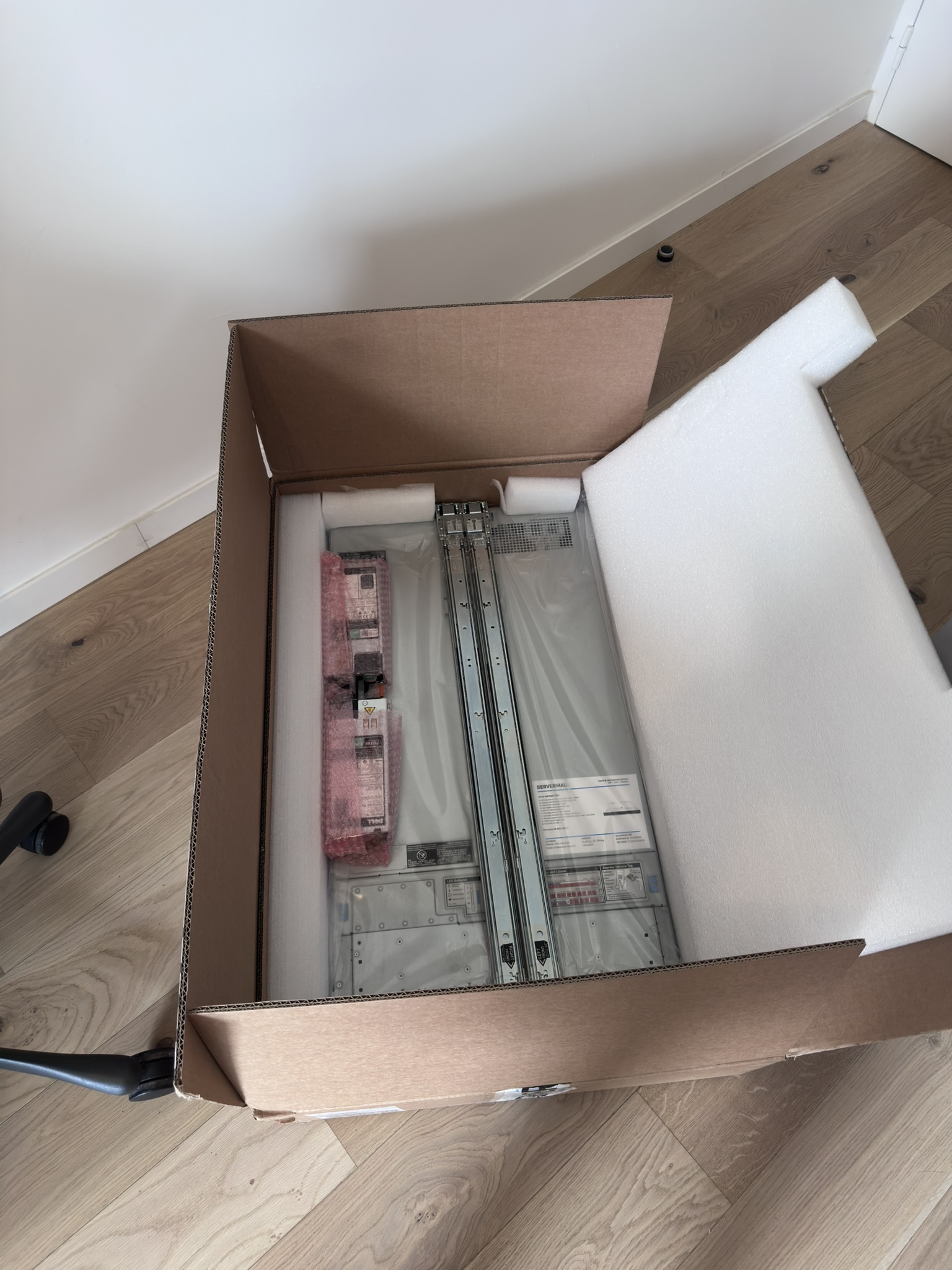
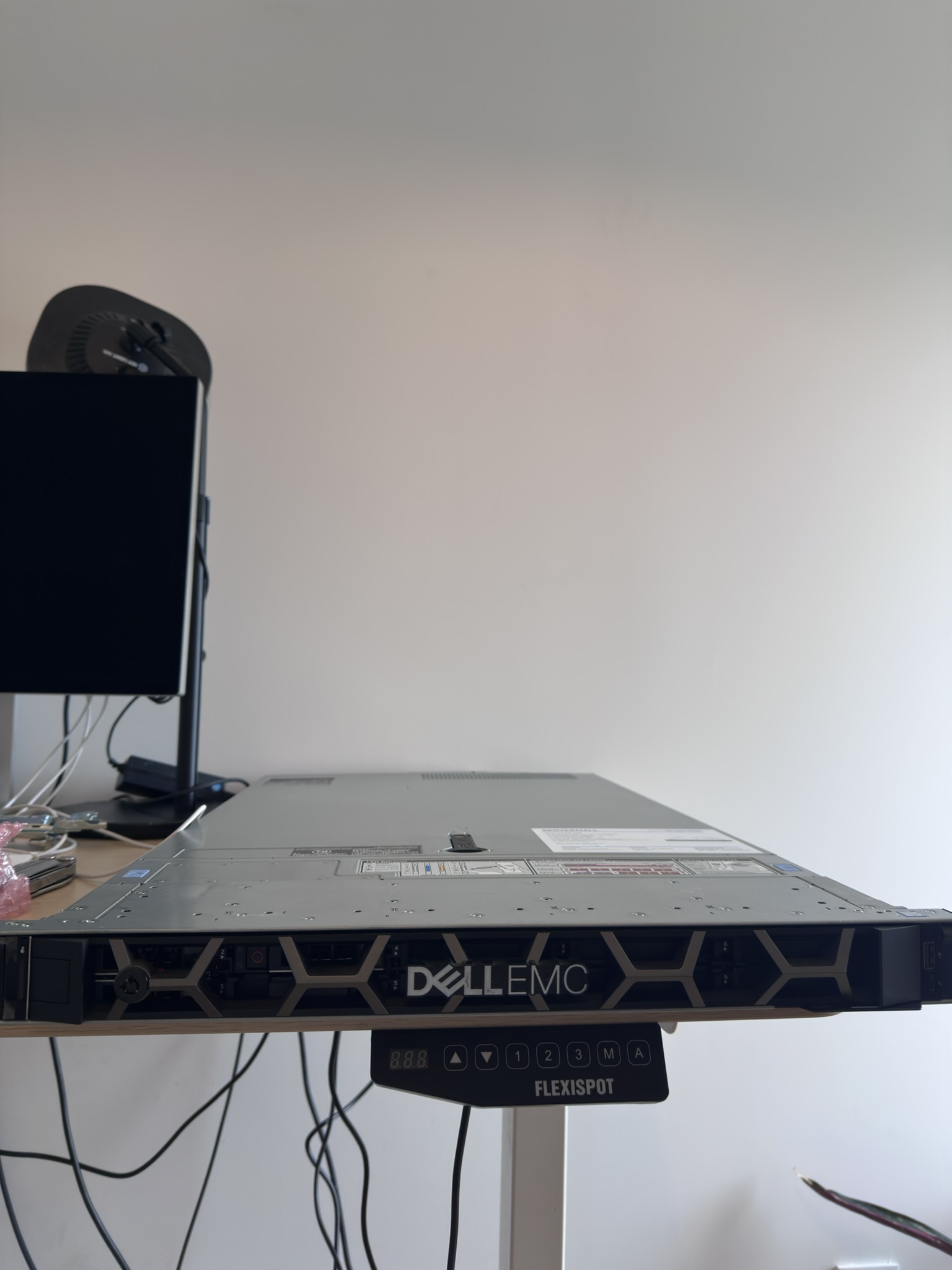
A refurbished Dell R640 (10SFF) was the answer:
- CPU: 2 × Intel Xeon Silver 4214 (12C, 2.20GHz) — 24 cores, 48 threads
- RAM: 4 × 32GB DDR4 RDIMM 2400MHz — 128GB total
- Storage: RAID Dell PERC H330 Mini, 2 × 240GB SSD in RAID1 + 1 × 1TB SSD
- Management: iDRAC Enterprise
- Power: Dual 750W power supplies
- No GPU Yet (coming soon)
Around €3,000. A one-time investment that would have covered maybe three months of equivalent cloud capacity.1
Having a Ton of Fun!
And here’s the thing nobody warns you about: it’s fun. Deeply, genuinely fun.
It started with the unboxing, I don’t consume a lot of tech, so this was already a thrill. Then the first boot, the hum of the fans, the iDRAC interface lighting up.
Suddenly I was thinking about challenges I did not consider when operating in the cloud: Should I run an HPC Kubernetes cluster directly, or Proxmox VMs with Kubernetes inside? RAID1 or RAID0 for the OS drives? What configuration in iDRAC for remote management?
Then came learning Proxmox, and realizing how much I’d forgotten about virtualization, resource allocation, and the quiet satisfaction of seeing a VM migrate from one node to another without dropping a connection.
Running intense load tests and seeing the machine handle them just fine, no throttling, no noisy neighbors, no surprise bill at the end of the month. Just deterministic, owned capacity.
Sharing access via Tailscale with friends to collaborate on projects. Seeing my GitHub Actions bill shrink as I replaced cloud runners with my own. The kind of fun I hadn’t felt since my early days at Dailymotion.
Knowledge & Constraints
I promise I won’t brag about my Proxmox configuration, but I’m now enjoying fine-tuning it, improving resource allocation, resiliency, and automating maintenance.
I’m also (re)learning a lot about specific hardware and network constraints, as well as some new things like iDRAC, power consumption strategies, and the quiet satisfaction of a well-racked server.
It’s important to mention as well that AI made a lot of those challenges easy to tackle. It became a good sparring partner and guide along this journey. While it’s still possible and recommended to learn through books and videos, it became really simple to fill the gaps in the knowledge required to operate your homelab.
My risk prone instinct, would make it even an immediately viable choice after the POC/Pitch phase of a startup, purely thanks to AI.
What’s Next?
I will rack the machine very soon in a DC2Scale datacenter. Not at home, for three reasons:
- My girlfriend will rightfully remind me that the noise and heat of this sweet 1U isn’t welcomed home
- I want to learn more about operating in datacenters, in optimal thermal and network conditions, and maybe with multiple machines
- Later down the road, I’ll probably want to learn about operating an Autonomous System, but that’s another story
I’ll likely post other articles to share more on what I’m working on. Join the cohort, have some fun experimenting! Trust me, we’re many to have forgotten how fun it is.
You don’t need to spend that much, ServerMall has refurbished 1U rack servers starting well under €500. Perfect for learning and smaller workloads. ↩︎